
Why Small Daily Habits Create Lasting Health Change
Why Small Daily Habits Create Lasting Health Change
By Dr. Ian Quitadamo, IHP3M, HPH, MS, PhD
Most people I talk to already know what they should be doing.
They know they should move more. Eat better. Get to bed at a reasonable hour. Manage stress instead of just absorbing it. The information isn't the problem — and it never really was.
What's missing isn't knowledge. It's consistency. And consistency isn't a willpower problem. It's a biology problem.
Your Brain Is Wired for Repetition, Not Perfection
When you repeat a behavior — any behavior — your brain begins to build dedicated neural pathways for it. This is called neuroplasticity, and it's one of the most important concepts in long-term health change.
The first time you do something new, the brain has to work hard. It's recruiting attention, weighing options, managing uncertainty. That's why starting a new habit feels effortful. But every time you repeat that behavior, the pathway becomes a little more established. A little more automatic.
Over time, what once required conscious effort becomes the default. That's not motivation — that's neuroscience.
This is why small, repeated inputs matter more than big, occasional efforts. Your brain doesn't optimize for intensity. It optimizes for frequency.
The Habit Loop — And What It's Actually Doing to Your Health
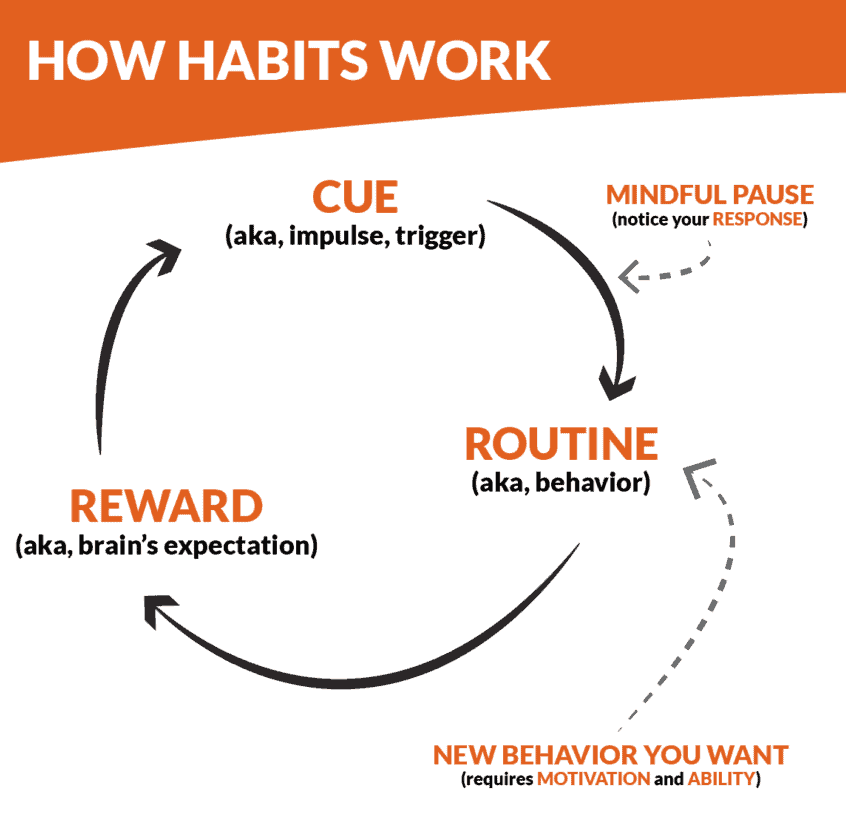
You may have heard of the habit loop: Cue → Craving → Response → Reward. It's a useful framework, but most people think of it in behavioral terms — as a tool for productivity or discipline.
What it's actually describing is a physiological loop.
The cue triggers a neurological signal. The craving activates dopaminergic pathways associated with anticipation. The response engages your nervous system, your musculoskeletal system, your metabolic system — depending on what the habit is. And the reward reinforces the loop through a release of neurotransmitters that tell your brain: do that again.
When the habits in that loop support your health — consistent movement, whole-food nutrition, quality sleep, stress regulation — you're not just building discipline. You're gradually shifting your baseline physiology. Lower resting cortisol. Improved insulin sensitivity. Better mitochondrial function. More consistent energy.
When the habits in that loop undermine your health, the same process works in reverse.
What 30 Minutes a Day Actually Does Biologically
The original version of this conversation usually goes: "Just 30 minutes a day can change your life." And while that's true, it misses the why — which is where the real motivation lives.
Here's what consistent 30-minute inputs actually do at a systems level:
Daily movement — even a 30-minute walk — activates AMPK, an enzyme that improves cellular energy metabolism and insulin sensitivity. Over weeks and months, this translates to measurable improvements in blood sugar regulation, cardiovascular markers, and body composition.
A 30-minute wind-down routine before bed — reducing screen exposure, dimming lights, gentle movement or breathing — supports melatonin onset and circadian rhythm regulation. Better sleep architecture means better recovery, better hormone balance, and better cognitive function the next day.
30 minutes of intentional stress reduction — whether that's breathwork, movement, time in nature, or simply disconnecting — helps regulate the HPA axis, the system responsible for your cortisol response. Chronically elevated cortisol is one of the most common drivers of fatigue, weight gain, brain fog, and immune dysfunction I see in my practice.
None of these require perfection. They require repetition.
Where Most People Get Stuck
The gap between knowing and doing usually comes down to one of three things:
The habit isn't connected to anything meaningful. When you understand that your morning walk is directly improving your insulin sensitivity and mitochondrial function — not just burning calories — the motivation shifts. It becomes a biological investment, not a chore.
The starting point is too ambitious. The research on behavior change is clear: smaller is more sustainable. A 10-minute walk you actually do every day outperforms a 45-minute workout you do twice before quitting. Start where compliance is easy, then build.
There's no feedback loop. One of the most powerful things I do with clients is show them their labs before and after a period of consistent inputs. When you can see that your inflammatory markers have dropped, your cortisol rhythm has normalized, or your metabolic panel has shifted — the habits become self-reinforcing. The biology becomes the motivation.
Building a Habit-Based Wellness Foundation
If you're looking to build habits that actually move the needle on your health, here's where I'd start:
Anchor to existing behavior. Attach a new habit to something you already do reliably. Morning coffee becomes the cue for a 10-minute walk. Getting into bed becomes the cue for a breathing practice. Existing routines carry new ones.
Choose one input at a time. The research doesn't support overhauling everything at once. Pick the one habit that would have the most downstream impact on how you feel — usually sleep, movement, or nutrition — and build consistency there first.
Track something meaningful. Not necessarily steps or calories. Track how you feel. Track your energy at 3pm. Track your sleep quality. Subjective data is still data, and it keeps you connected to why the habits matter.
Give it 66 days, not 21. The popular claim that habits form in 21 days comes from a misread of older research. More recent studies suggest the average is closer to 66 days — with significant individual variation. Give yourself a realistic timeline.
The Long View
Lasting health isn't built in a 30-day challenge or a detox program. It's built in the accumulated weight of small, consistent inputs over months and years.
That's not a discouraging idea — it's actually a liberating one. Because it means you don't have to be perfect. You just have to be consistent. And consistency, as it turns out, is something your brain is extraordinarily good at when you give it the right conditions.
If you're not sure where to start — or you've tried before and couldn't make it stick — that's exactly what a Discovery Call is for. We'll look at where you are, what's getting in the way, and what inputs are most likely to move the needle for your specific biology.
Small steps. Real change. That's what we do.
Dr. Ian Quitadamo is an Integrative Health Practitioner and research scientist with 30+ years spanning cell and molecular biology, functional health, and performance coaching. IQ Performance Health serves clients locally in Ellensburg, WA and virtually across the United States.


